
Energy Storage Solution
Dany Maalouf
Tech. Director of DC Design & Construction
Edarat Group
Executive Summary:
The increasing demand for Data Centers and their high computing capabilities and the introduction of renewable energy to decarbonize the power grids are the main incentives for data center owners and transmission system operators to implement solutions that can be the remedy for reducing the associated impacts. The above cannot be achieved without allowing the introduction of renewable power generation to cater for higher load demands and to reduce reliance on fossil fuel generation thus reducing the impact on environment. Also, it cannot be achieved without affecting the grid resiliency and stability during high fluctuation of energy production and energy consumptions imposed by different time periods and weather conditions. The battery energy storage system, which is the subject of this paper, is considered a good remedy for both solving the above issues and imposing other benefits at the same time.Â
Introduction
The paper begins by explaining the growing need for energy storage systems, especially Battery Energy Storage Systems (BESS), in data centers. This need arises from the global shift toward low-carbon energy sources to combat climate change and reduce environmental impact.Â
Traditional fossil-fuel-based systems provided inertia, helping stabilize the grid during demand fluctuations. However, renewable sources like solar and wind are variable and slower to respond, leading to potential grid instability.Â
The paper begins by explaining the growing need for energy storage systems, especially Battery Energy Storage Systems (BESS), in data centers. This need arises from the global shift toward low-carbon energy sources to combat climate change and reduce environmental impact.Â
Traditional fossil-fuel-based systems provided inertia, helping stabilize the grid during demand fluctuations. However, renewable sources like solar and wind are variable and slower to respond, leading to potential grid instability.Â
Transition to Low-Carbon Energy Systems
The global shift from fossil fuels to cleaner energy sources like solar and wind is accelerating. While this transition supports climate goals, it introduces grid stability challenges due to the intermittent nature and low inertia of renewable energy:
BESS offers a solution:Â
At large scale, it supports grid transmission and distribution.
At small scale, it serves as behind-the-meter storage for consumers.
For data centers, BESS—combined with UPS systems—can:Â
Provide on-site backup power.
Support grid stability.
Unlock revenue opportunities through participation in energy markets and regulatory programs.
Transition to Low-Carbon Energy Systems
The global shift from fossil fuels to cleaner energy sources like solar and wind is accelerating. While this transition supports climate goals, it introduces grid stability challenges due to the intermittent nature and low inertia of renewable energy.
Key Challenges
Energy Availability: Demand is rising faster than infrastructure can keep up.
Renewable Variability: Solar and wind are weather-dependent and unpredictable.
Grid Congestion: Caused by:
- Transmission limitations
- Urban demand clustering
- Integration delays of renewables
Reliability Risks
- Reduced inertia from non-synchronous generation (e.g., solar/wind) can lead to frequency instability.
- Urban demand clustering
- Integration delays of renewables
Smart Solutions:
- Grid Modernization: Infrastructure upgrades for better load balancing.
- Demand Response: Shifting consumption to off-peak times.
- Distributed Generation: Local energy sources reduce grid pressure.
- AI & Forecasting: Predictive tools for better energy planning.
- Energy Storage (BESS): Stores excess renewable energy for use during peak demand.
Need for Ancillary Service Systems
Electricity delivery involves multiple stages—generation, transmission, and distribution—each requiring ancillary services to maintain grid stability and reliability.Â
Key Ancillary Services:
- Frequency regulation
- Voltage control
- Spinning and non-spinning reserves
- Black start capability
- Load balancing
As renewable energy penetration increases, grid fluctuations become more common, intensifying the need for these services. This opens up opportunities for Distributed Energy Resources (DERs)—especially energy storage systems like BESS—to play a critical role in supporting grid operations.Â
Inertia & RoCoF
As power systems transition toward decarbonization and phase out nuclear and fossil-based synchronous generators, the grid loses a critical stabilizing factor: inertia.Â
What is Inertia?
- Provided by rotating masses in traditional generators.
- Delays frequency drops during disturbances, giving time for reserves to respond.
Impact of Renewables:
- Solar and wind (inverter-based) do not contribute inertia.
- This leads to a faster Rate of Change of Frequency (RoCoF), risking grid instability.
Compounding Factors:
- Grid expansion increases oscillation complexity.
- Extreme weather stresses systems.
- Power flows shift from periphery to center.
- Market dynamics and inverter-based loads worsen frequency behavior.
Consequences:
- Reduced short-circuit power affects protection systems.
- Voltage dips become deeper and more widespread.
- Reactive power issues and active power transients weaken grid stability.
Challenge:
Maintaining a safe RoCoF limit is essential to ensure the grid can withstand stress and avoid cascading failures.Â
Frequency Regulation
Frequency regulation is a vital ancillary service that ensures grid stability by maintaining the system frequency (typically 50 or 60 Hz) within acceptable limits. It corrects imbalances between electricity supply and demand in real time.Â
Types of Frequency Stability:
- Long-Term (minutes): Influenced by forecasting, systemic imbalances, and primary control.
- Short-Term (seconds): Depends on system inertia, generator response, and fast-acting reserves.
Role of Energy Storage:
- Fast-acting systems like BESS are essential for short-term frequency regulation.
- Unlike traditional demand-side strategies, frequency regulation focuses on power availability, not energy consumption.
Global Adoption:
Utilities in Europe, North America, and Australia are increasingly using energy storage systems for frequency regulation.Â
- These programs also allow demand-side loads to participate in ancillary service markets, boosting grid flexibility and resilience.
Power System Inertia
Inertia in power systems is the grid’s ability to resist sudden frequency changes, especially during disturbances like generator outages or demand spikes. It’s crucial for maintaining grid stability.
Traditional Inertia:
- Comes from rotating masses in synchronous generators (coal, gas, hydro, nuclear).
- These machines automatically buffer frequency changes, buying time for control systems to respond.
Renewable Energy Challenge:
- Solar and wind are inverter-based and do not provide inertia.
- Variable Frequency Drives (VFDs) in industrial loads further reduce inertia.
- This leads to faster Rate of Change of Frequency (RoCoF), increasing blackout risks.
Impact of Low Inertia:
- Deeper and faster frequency drops.
- Greater reliance on fast-response mechanisms like BESS.
- Risk of under-frequency load shedding and grid segmentation.
Mitigation Strategies:
- Curtail non-synchronous generation (limits clean energy use).
- Use fossil-fueled spinning reserves (adds cost and emissions).
- Reduce output from large synchronous units (financial trade-offs).
Reserves in Low-Inertia Grids
As traditional synchronous inertia declines due to increased renewable energy, grids rely more on fast-acting reserves to manage sudden frequency drops caused by events like generator outages.
Key Reserve Types:
- FCR-D (Frequency Containment Reserves for Disturbances): Activates within seconds to stabilize frequency.
- FFR (Fast Frequency Response): Reacts in under one second, ideal for low-inertia environments.
These reserves:
- Automatically respond to frequency deviations.
- Inject power or reduce demand to restore balance.
- Deactivate once normal frequency is restored.
Energy Storage Technologies Supporting Reserves:
- Pumped Hydro
- Compressed Air (CAES)
- Flywheels
- Supercapacitors
- Thermal Storage
- Battery Energy Storage Systems (BESS) – most widely adopted.
Energy Storage Technologies Supporting Reserves:
- Grid-Integrated BESS: Large-scale, utility-owned, used for grid balancing and congestion management.
- Behind-the-Meter (BTM) BESS: Smaller-scale, user-owned, supports peak shaving, backup power, and market participation.
The paper emphasizes BTM BESS as the most impactful and flexible solution for modern energy systems.
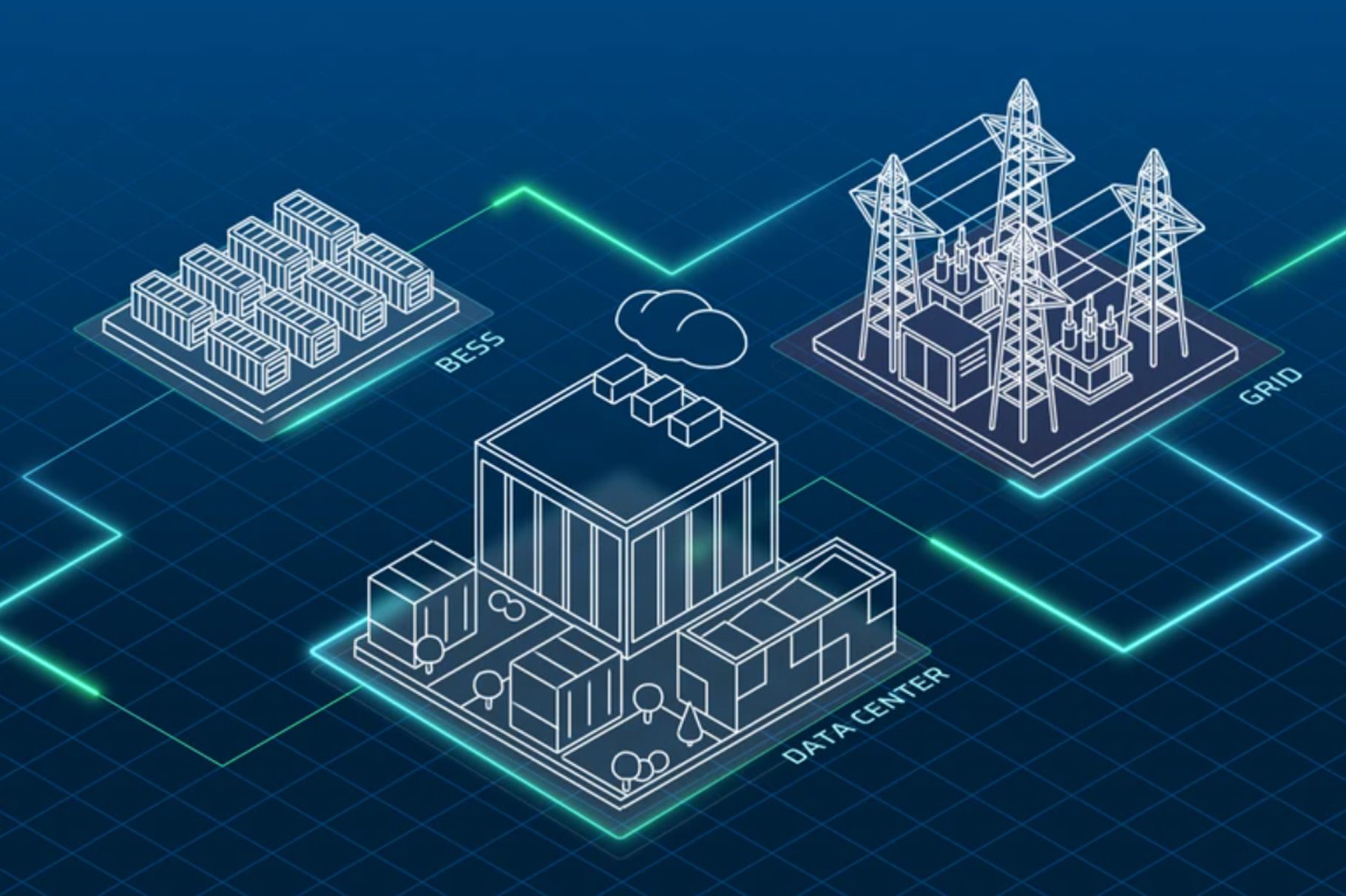
Data Centers & UPSs in Fast Frequency Response (FFR)
Modern data centers rely on backup generators and Uninterruptible Power Supplies (UPS) to ensure continuous power. While generators can support ancillary services, they are not ideal for rapid frequency regulation due to emissions and slow response times.

UPS Systems as Grid Assets:
- Distribution Deferral – Delay costly upgrades to distribution systems.
- Transmission Congestion Relief – Reduce congestion charges.
- Transmission Deferral – Postpone transmission infrastructure investments.
Dual Functionality:
- UPS systems can modulate power in real time.
- They enable:
- Grid service participation (FFR, peak shaving)
- Continuous backup for IT loads
- Seamless integration of flexibility and protection
Smart Control:
- Advanced algorithms allow UPS to:
- Allocate battery energy for grid support
- Preserve backup capacity
- Prioritize load protection during faults
UPS systems must fail safely, reverting to their primary role of protecting critical infrastructure if grid conditions become unstable.
BESS Grid Services
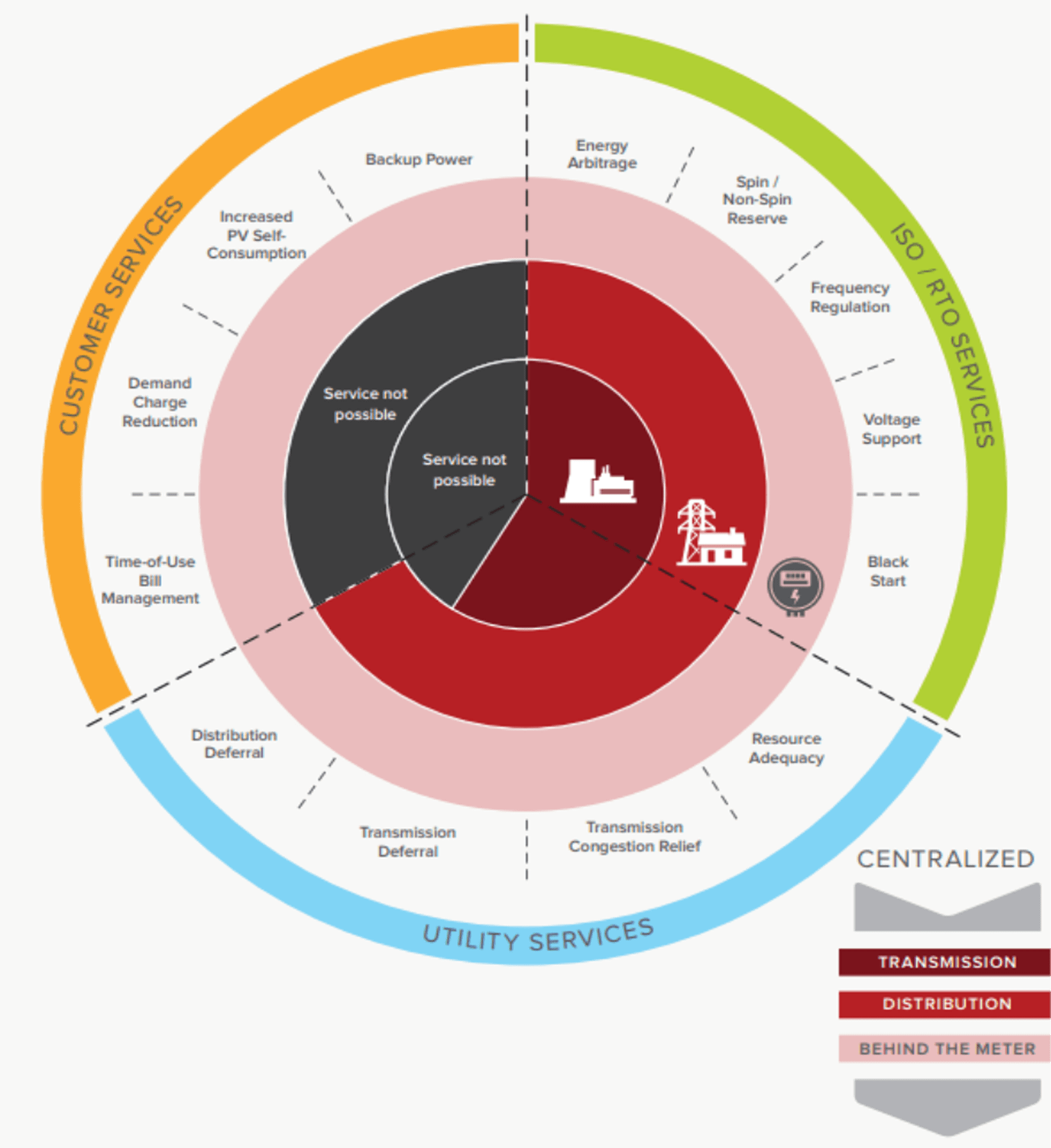
Battery Energy Storage Systems (BESS) can deliver 13 distinct services across three stakeholder groups: ISOs/RTOs, utilities, and customers. These services enhance grid stability, reduce costs, and create revenue opportunities—especially for behind-the-meter (BTM) applications.
ISO/RTO Services:
- Energy Arbitrage – Buy low, sell high in wholesale markets.
- Frequency Regulation – Instant response to frequency changes.
- Spinning/Non-Spinning Reserves – Backup power for contingencies.
- Voltage Support – Maintain voltage within safe limits.
- Black Start – Restore grid after outages.
Utility Services:
- Resource Adequacy – Avoid over-investment in new generation.
- Distribution Deferral – Delay costly upgrades to distribution systems.
- Transmission Congestion Relief – Reduce congestion charges.
- Transmission Deferral – Postpone transmission infrastructure investments.
Customer Services:
- Time-of-Use Bill Management – Shift energy use to cheaper periods.
- Increased PV Self-Consumption – Maximize solar energy usage.
- Demand Charge Reduction – Lower peak demand costs.
- Backup Power – Ensure reliability during outages.
BESS Deployment Across the Grid
Battery Energy Storage Systems (BESS) can deliver 13 distinct services across three stakeholder groups: ISOs/RTOs, utilities, and customers. These services enhance grid stability, reduce costs, and create revenue opportunities—especially for behind-the-meter (BTM) applications.
Transmission Level
- High-voltage zone (115–765 kV)
- Includes central generation plants, transmission lines, and substations
- Ideal for large-scale grid services like balancing, frequency control, and black start
Distribution Level
- Medium-voltage zone (4–69 kV)
- Covers distribution lines and substations serving commercial/industrial users
- Supports services like voltage support, congestion relief, and distribution deferral
Behind-the-Meter (BTM)
- Located on the customer side of the meter
- Found in residential, commercial, or industrial buildings
- Enables cost-saving services like peak shaving, backup power, and participation in ancillary markets
The above figure illustrates the range of services that BESS can offer to each of the three electricity grid stakeholders, based on both centralized and distributed installation types.
Data Center Energy Storage Economics
Energy storage systems are increasingly used in data centers to participate in ancillary services like peak shaving, frequency regulation, and Fast Frequency Response (FFR), which offer higher revenue potential than traditional energy markets.
Economic Advantage for Data Centers:
- UPS systems are already part of data center infrastructure.
- Retrofitting UPS for grid services requires minimal additional investment compared to building standalone BESS.
Additional Benefits:
- Lower carbon emissions
- Reduced resource consumption
- Enhanced sustainability
Cost Comparison: BESS vs. UPS Retrofit
Infrastructure Element
>1 MW BESS
Data Center UPS Retrofit
Battery + Converter System
~50% of total cost
Already installed
Grid Connection, Site, etc.
~50% (property, civil works)
Covered by data center design
Incremental Cost for Grid 
Support
Full investment required
Marginal control upgrades only
By leveraging existing UPS infrastructure, data centers can cut capital costs and unlock new revenue streams through participation in energy markets.
Key Drivers Behind BESS Adoption
Battery Energy Storage Systems (BESS) are gaining widespread adoption due to a combination of technological advancements, market needs, and regulatory support.
Technological & Market Drivers
- Grid Reliability & Resilience: BESS stabilizes frequency, supports voltage, and provides backup during outages.
- Decarbonization Goals: Reduces reliance on fossil fuels, helping meet sustainability targets.
- Renewable Integration: Stores excess energy from solar/wind and releases it when needed.
- Cost Savings & Energy Arbitrage: Enables energy independence and reduces peak demand charges.
Declining Battery Costs
- Lithium-ion batteries are becoming more affordable.
- Cost dropped from $7500/kWh by (1991) to $133/kWh by (2024), with projections of $88/kWh by (2030).
Policy & Incentives
- Governments offer subsidies, tax credits, and mandates.
- Programs like capacity markets, TOU pricing, and net metering improve ROI.
Commercial & Industrial Demand
- Businesses seek energy reliability, cost control, and sustainability.
- BESS supports critical operations and reduces demand charges.
BESS Benefits for Data Centers
Battery Energy Storage Systems (BESS) are gaining widespread adoption due to a combination of technological advancements, market needs, and regulatory support.
Extended Backup Power Duration
- Traditional UPS: 5–15 minutes
- BESS: 1–4+ hours
- Reduces reliance on diesel generators during outages.
Improved Power Reliability
- Ensures continuous power during grid disturbances.
- Minimizes downtime and lowers Scope 1 emissions.
- Ideal for sites facing environmental and noise regulations.
Market Participation
- Enables participation in reserve markets and grid services.
- Keeps data centers connected to the grid, reducing emissions compared to generator-based support.
Demand Charge Reduction & TOU Management
- Discharges during peak demand to reduce costs.
- Charges during off-peak hours for time-of-use (TOU) optimization
- Unlocks new revenue streams via services like frequency regulation and demand response.
Increased Use of Renewables
- Stores surplus renewable energy for later use.
- Reduces curtailment and improves clean energy utilization.
- Supports Scope 2 emissions reduction by discharging during high-carbon periods.
BESS Components & Management Systems
AÂ Behind-the-Meter (BTM) BESSÂ for data centers includes several integrated components designed for safe, efficient, and flexible energy storage and grid interaction.
Core Components:
- Batteries: Large-format lithium-ion (LFP or NMC) packs with Battery Management System (BMS) for safe charge/discharge.
- Power Conversion System (PCS): Bidirectional inverter converts DC ↔ AC and manages energy flow between grid, batteries, and loads.
- Cooling & Ventilation: Maintains thermal limits using forced-air, liquid, or passive systems.
- Fire Detection & Suppression: Includes heat, smoke, and gas sensors with anti-deflagration measures.
- Electrical Protection: Circuit breakers, fuses, and surge protectors ensure fault isolation and system safety.
Control & Monitoring:
- Tracks battery health, SoC, energy flow, temperature, and fault events.
- Enables grid interaction settings for services like frequency regulation and black start.
Energy Management System (EMS):
- Optimizes charge/discharge cycles based on energy usage, grid conditions, and renewable input.
- Supports goals like cost savings, load balancing, carbon reduction, and backup provisioning.
- Can integrate with Virtual Power Plants (VPPs) for market participation.
Data Center Integration:
- Seamlessly connects to electrical panels, distribution boards, and Power Monitoring Systems (PMS).
- EMS coordinates microgrid signals and IT load demands for reliable and efficient operation.
Lithium-Ion BESS
Lithium-ion batteries are the most vital and expensive part of a Battery Energy Storage System (BESS). Selecting the right chemistry and configuration is key to optimizing performance, safety, and cost.
Cell Chemistries:
- NMC (Nickel Manganese Cobalt): High energy density; ideal for space-constrained setups.
- LFP (Lithium Iron Phosphate): Safer, longer lifespan, higher power output; preferred for most BESS applications.
Key Metrics:
- C-Rates: Define charging/discharging speed.
- Voltage, Capacity, Energy, Power: Determine system size and output.
- Volumetric Energy Density: Affects space requirements.
- Cycle Life: Typically 4,000–6,000 cycles; influenced by temperature and depth of discharge.
Battery Management System (BMS):
- Monitors voltage, temperature, State of Charge (SoC), and State of Health (SoH).
- Ensures safe operation and longevity.
Cell Balancing Methods:
- Passive: Matches cells to the lowest SoC; cost-effective but less efficient.
- Active: Redistributes energy evenly; more efficient but costlier and complex.
Conclusion
The energy storage market is rapidly evolving, and in the coming years, we can expect the introduction of innovative materials and technologies that will continue to reshape storage systems. This evolution is driven by the growing importance of energy storage in several key areas — including grid stability, enabling higher renewable energy integration, and reducing carbon emissions.
However, realizing these benefits depends heavily on two critical factors: the continued decline in manufacturing costs and the implementation of supportive regulations and standards by governments. These developments are essential to making energy storage solutions more cost-effective and attractive for investment.
Share this post
I skimmed the piece and it clearly tackles energy storage needs for data centers and grid resilience—totally in the sustainability and tech operations space. For pros in beauty, efficiency and reliability matter too, especially for clinics and studios running 24/7 with equipment and skincare tech. In Suplery we offer a professional beauty business platform that streamlines inventory and orders, plus a built-in shop, so your stock and sales are always on point. It also includes real-time stocktakes and a shared cart for faster procurement, which scalp clinics and waxing studios will love. If you’re serious about smooth ops, Suplery can be a must-use solution with reliable supplier communication. Consider checking it out.